Best Glass Beads for Bracelets: 9 Picks UK Makers Reach For
If you want a bracelet that holds its shape, catches light and survives daily wear, the bead you string matters as much as the pattern. Glass is the material most UK makers reach for first, because it comes in every colour, takes a facet or a matte finish, and sits at a price that lets you buy enough to finish the piece. This guide names the nine glass beads we sell most for bracelets, tells you the size and shape of each, and says plainly what each one is good at, so you can match the bead to the bracelet you actually want to make.
We stock the full range that follows, and UK orders placed before 12 noon leave our Clacton-on-Sea warehouse the same day, so you can start the project this week rather than next.
You can browse the whole selection in our glass beads range, sorted by type so you can match a bead to a bracelet in a couple of taps, with same-day UK dispatch on orders before noon.
What makes a glass bead good for a bracelet?
A good bracelet bead has a hole that fits your stringing material, a weight the wrist can carry all day, and a finish that survives contact with skin, cuffs and door handles. Bracelets take more knocks than necklaces or earrings, so the bead needs to be tough at the hole and stable in colour. Glass wins on all three counts: the hole is drilled clean, most glass beads are light enough to string in quantity, and a fired glass finish does not rub off the way some coated plastics do. Size and shape then decide the technique. Small uniform beads suit stitched cuffs, larger rounds suit stretch and charm bracelets, and flat two-hole shapes give you a band that stays rigid.
With that test in mind, here are the nine we recommend most.
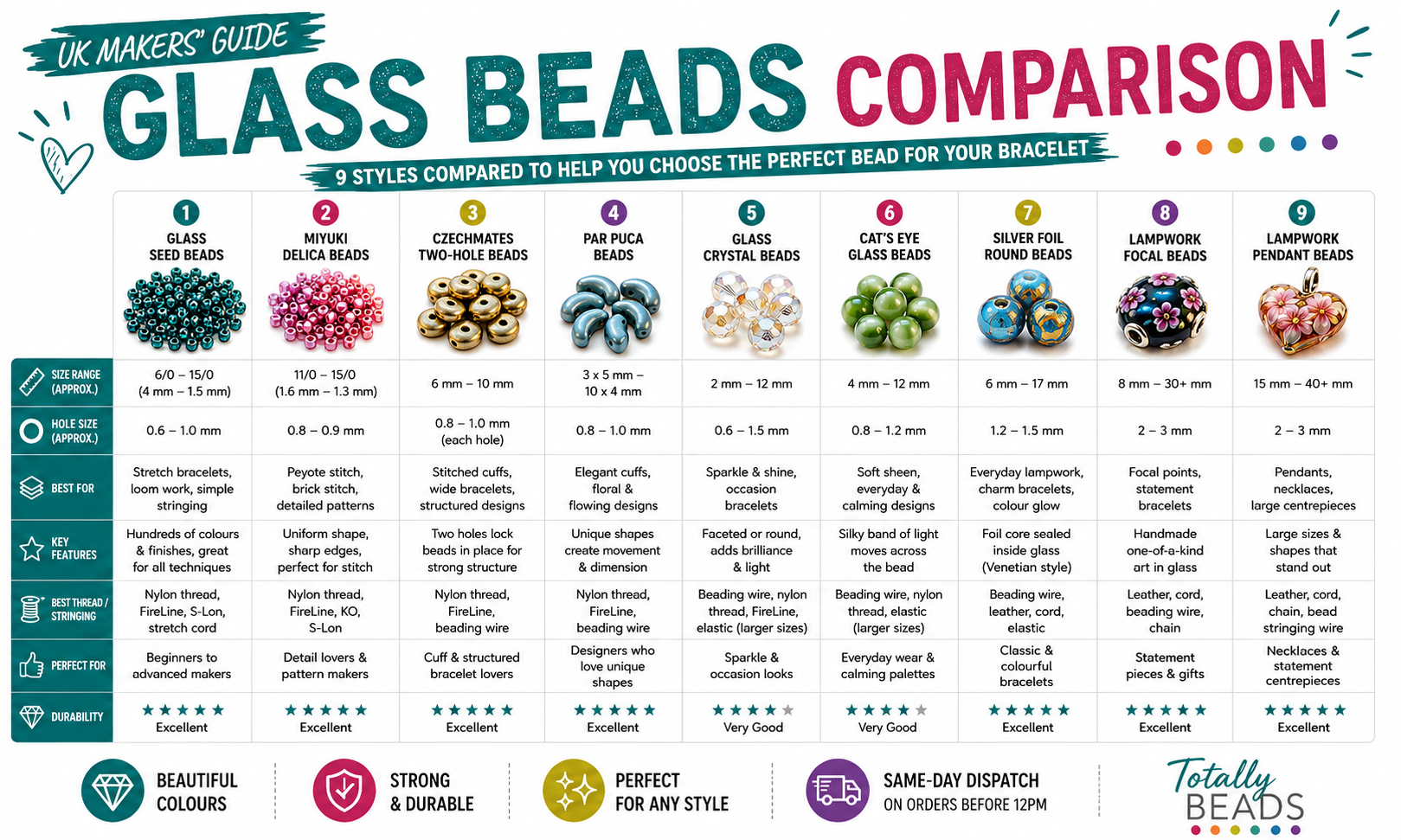
The 9 glass beads UK makers reach for
Glass seed beads (the everyday workhorse)
Glass seed beads are the first bead most bracelet makers buy, because they string fast, stitch cleanly and come in every colour. These small rounded beads, properly called rocailles, run from a chunky 6/0 down to a fine 15/0, with 8/0 and 11/0 the common bracelet sizes. An 8/0 gives a bolder strung line and threads easily for beginners; an 11/0 gives a finer, denser cuff. They suit stretch bracelets, loom work and simple peyote bands equally. Start here with our glass seed beads, stocked across the sizes and colours that carry most bracelet patterns.
Miyuki Delica cylinder beads (for flat, precise cuffs)
Miyuki Delica beads are precision-cut Japanese cylinders, and they are the bead to reach for when you want a bracelet with clean, even walls. The default size is 11/0, roughly 1.6 by 1.3 mm with a hole around 0.8 mm and about 200 beads to the gram, and they also come in 15/0 and 8/0. Because the ends are flat rather than rounded, Delicas sit wall to wall in peyote and loom work, which is why cuff patterns are usually written for them. A DB code names the colour and finish only, not the size, so DB625 is the same colour whether you buy it in 11/0 or 8/0. Match a pattern exactly from our Miyuki Delica range, with the DB codes listed so you can order the precise colour a chart calls for.
Toho seed beads (consistent holes, easy passes)
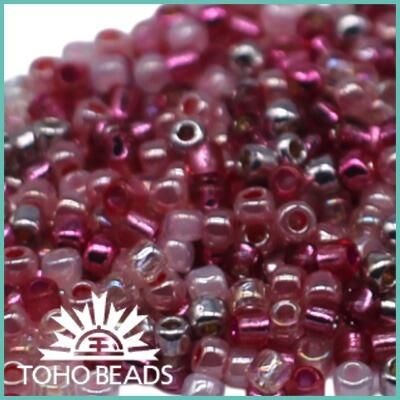
Toho seed beads are the choice when your pattern needs several thread passes through the same bead. Toho rounds are known for their uniform shape and generous, rounded holes, which means the needle goes through cleanly even on the third or fourth pass, where a tighter bead would jam. That makes them reliable for right-angle weave and embellished bracelets that build up density. They sit happily alongside Delicas in the same size, so you can mix a rounded Toho accent into a cylinder cuff. See the colours in our Toho seed beads range, picked for even sizing and holes that take repeat passes.
Czech fire-polished glass (sparkle without the price)
Czech pressed and fire-polished glass beads give a bracelet its sparkle at a fraction of cut-crystal cost. These faceted rounds catch light from every angle and come in bracelet-friendly sizes from 3 mm up to 8 mm, so you can use the small ones as spacers and the larger ones as feature beads on a stretch or charm bracelet. Czech glass holds colour well and the facets stay crisp with wear. Explore the shapes and finishes in our Czech glass beads range, from tiny faceted spacers to statement rounds.
CzechMates two-hole shapes (structure that stays flat)
CzechMates beads solve the problem single-hole beads cannot: they keep a bracelet band rigid. This is a coordinated system of flat two-hole shapes, including Tiles, Bricks, Bars, Lentils, Crescents and Daggers, all designed to the same scale so they lock together. Because each bead is held by two threads, a CzechMates cuff sits flat on the wrist rather than twisting. They are a fast route to a structured bracelet for a maker moving on from simple stringing. Build with them from our CzechMates range, a matched two-hole system that snaps into flat, sturdy bands.
Par Puca two-hole shapes (geometric bands)
Par Puca beads are French-designed and Czech-pressed, and they give a bracelet a sharp, geometric line. The family includes Kheops, Arcos, Minos, Amos and Ava, each a distinct two-hole shape that interlocks with seed beads to form a pattern. Like CzechMates, the two holes give the band its backbone, but the angular shapes produce a more architectural look, which suits a maker who wants a bracelet that reads as designed rather than strung. Pair them with an 11/0 seed bead from our Par Puca range, the French-designed two-hole shapes for structured bracelet bands.
Crystal glass beads (for occasion and gift bracelets)
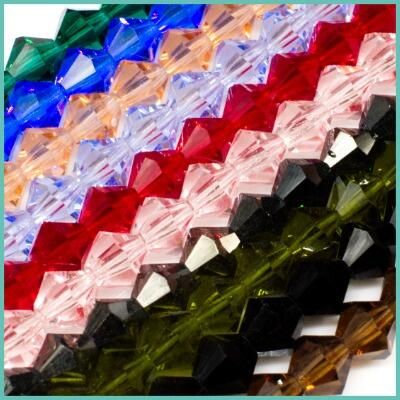
Crystal glass beads are the ones to reach for when a bracelet needs to shine for a wedding, a birthday or a Christmas gift. These faceted glass beads, in bicone and round cuts, throw more light than a plain round and give an occasion piece its lift, all without the cost of a natural gemstone. They string beautifully on elastic for a quick gift bracelet or on wire for something more permanent. Browse the colours in our crystal beads range, faceted glass that adds sparkle to a gift or occasion bracelet.
Frosted glass beads (a softer, matte look)
Frosted glass beads suit the maker who wants a calm, muted bracelet rather than a shiny one. The etched matte surface diffuses light instead of reflecting it, which gives a gentle, tactile finish that pairs well with brushed metal findings and neutral palettes. They wear comfortably and hide fingerprints and small scuffs better than a high-gloss bead, so they hold their look on an everyday bracelet. See the tones in our frosted glass beads range, matte-finished glass for understated everyday bracelets.
Cats-eye glass beads (a moving band of light)
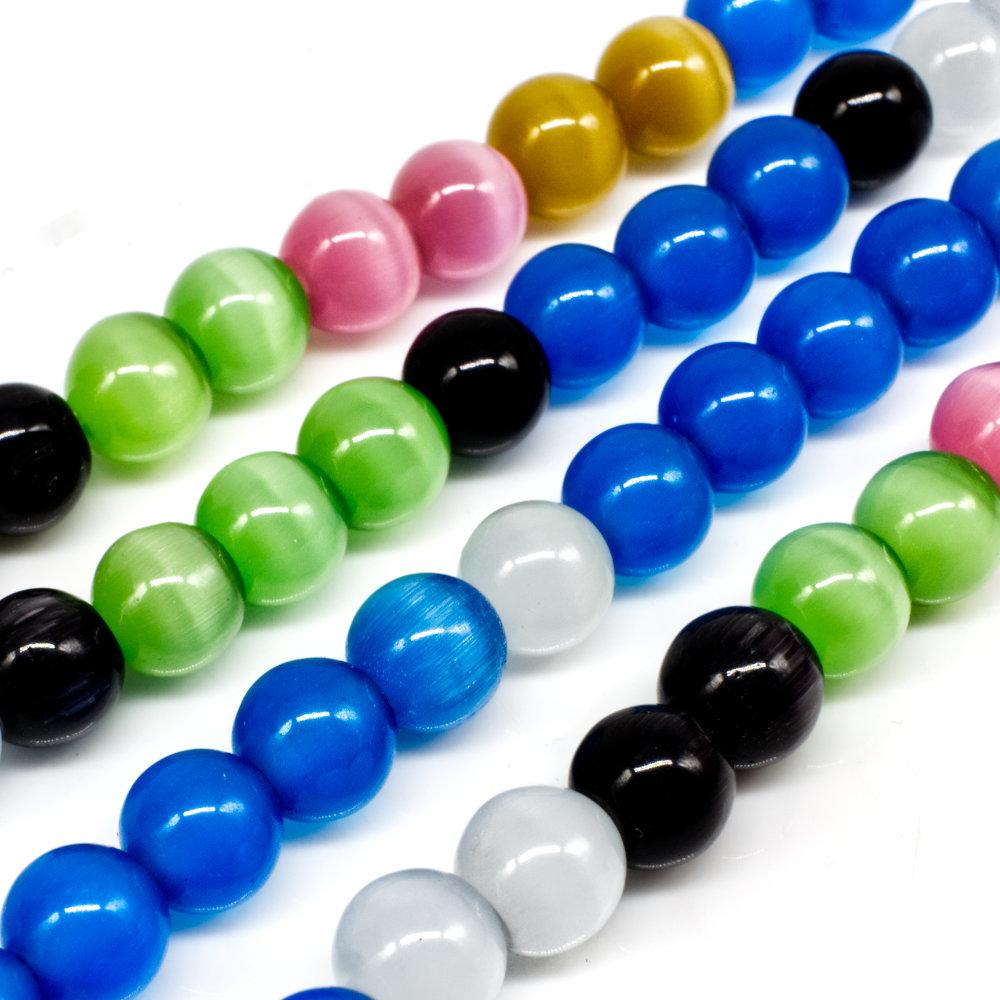
Cats-eye glass beads finish the list with the most eye-catching effect for the least effort. These are fibre-optic glass beads with a bright band of light that shifts as the bead turns, an effect called chatoyancy, and on a simple stretch bracelet a single strand of them looks far more expensive than it costs. They come in strong, clear colours and drilled round shapes, so a beginner can make a striking bracelet with nothing more than elastic and a knot. Add a pop of colour from our cats-eye glass beads range, fibre-optic rounds with a moving line of light.
Which glass bead should you choose for your bracelet?
Choose by the technique you plan to use, not the colour you like first. For a flat stitched cuff, pick Miyuki Delicas for their even walls or Toho seed beads for their easy thread passes. For a structured band with a designed look, pick CzechMates or Par Puca two-hole shapes. For a quick strung or stretch bracelet, pick crystal, cats-eye or Czech fire-polished rounds, with seed beads as spacers. If you are still weighing materials in general, our guide on how the different glass bead types compare for weight, sparkle and durability sets them side by side, and if you are unsure whether to reach for a seed bead or a pressed glass bead, our breakdown of where seed beads and glass beads each earn their place settles it.
How much glass to buy, and what to string it on
Buy enough beads to finish the bracelet in one go, and buy the thread and finding with them. A strung 7.5 inch bracelet in 8 mm rounds needs about 24 beads plus a clasp; the same length in 6 mm needs about 32. For stitched cuffs, weigh by the gram: a small peyote band in 11/0 Delicas uses roughly 5 to 8 grams. Match the thread to the hole, so an 11/0 Delica or seed bead with its 0.8 mm hole takes a size 12 needle with Fireline or S-Lon, and drop to a finer thread when a bead needs four or more passes. Finishing well is what separates a bracelet that lasts from one that frays, and our guide on crimping, clasps and neat professional endings walks through it.
Two makers, two glass bracelets
A beginner wanted a first stretch bracelet for a friend's birthday and had never beaded before. She bought one strand of 8 mm cats-eye glass in teal, a length of clear elastic and nothing else, strung 22 beads to a 7.5 inch fit, tied a surgeon's knot and dabbed it with clear glue. The finished bracelet took twenty minutes and looked like a shop piece, which is exactly why cats-eye glass is the bead we point new makers to first.
A more experienced beader wanted a flat cuff that would not twist. She chose CzechMates Tiles in matte bronze with an 11/0 Toho seed bead to bridge them, threaded both holes on Fireline with a size 12 needle, and worked a two-drop band. Because every Tile was held by two threads, the cuff came off the mat dead flat, sat square on the wrist and needed no stiffening. Ten grams of Tiles and five grams of seed beads finished a 7 inch cuff with a sensible margin left over.
Frequently asked questions
Cats-eye glass rounds and 8 mm Czech fire-polished beads are the easiest starting point, because they string straight onto elastic and need no stitching. Add glass seed beads as spacers and you have a complete bracelet with one knot.
For strung and stretch bracelets, 6 mm and 8 mm rounds sit and knot well. For stitched cuffs, 11/0 seed beads or Miyuki Delicas give the finest result, with 8/0 a good size for a bolder, faster band.
Yes. Fired glass keeps its colour and finish through daily wear, and the drilled holes are clean and strong. Frosted and matte glass in particular hides small scuffs better than a high-gloss bead.
Seed beads are rounded and slightly irregular, while Delicas are flat-ended cylinders that sit wall to wall. Patterns written for one do not translate cleanly to the other, so follow the bead the chart specifies.
Use clear elastic for a quick stretch bracelet, beading wire with crimps for a strung bracelet, and Fireline or S-Lon with a size 12 needle for stitched cuffs. Match the thread to the bead hole so the needle passes freely.
Ready to make yours
The right glass bead is the one that fits the bracelet you want to build, whether that is a flat Delica cuff, a structured CzechMates band or a five-minute cats-eye stretch bracelet for a gift. We stock all nine picks above alongside the thread, needles and clasps to finish them, and UK orders placed before 12 noon dispatch the same day from our Clacton-on-Sea warehouse.
full glass beads range, sorted by type so you can match the bead to your project and check it out in one basket