
Tiger Eye Bracelet Meaning and the Best Tiger Eye Beads to Buy
A tiger eye bracelet is traditionally worn as a symbol of steadiness and quiet confidence, and the beads most people use to make one are 8 mm golden rounds on a 15 inch string. That is the short answer. The longer one covers which colours are natural and which are dyed, how many beads a bracelet actually takes, what to string them on so the piece survives daily wear, and what to check on a string before you buy it.
Most articles about tiger eye are written for someone wearing a finished bracelet. This one is written for someone making it. If you want to know what the stone means, that is here. If you want to know how many 8 mm beads come off a 15 inch string and what a finished bracelet costs you in materials, that is here too, and almost nowhere else.
Key takeaways
✓Golden tiger eye is the classic. Blue tiger eye, sometimes called hawk's eye, is the natural blue variety.
✓Red tiger eye is usually produced by gentle heat treatment. Bright greens and pinks are dyed, whatever the trade name says.
✓A 15 inch string of 8 mm rounds holds roughly 47 beads, which is about two bracelets for an average wrist.
✓The 0.8 mm drill hole on most tiger eye decides your stringing. Use 0.8 mm round elastic or tigertail, not thick cord.
✓Never put tiger eye in an ultrasonic cleaner. A soft dry cloth is the whole cleaning routine.
✓Buy the full quantity of one colour in one order. Natural stone varies between batches and a reorder rarely matches.
Browse the tiger's eye bead range at TotallyBeads. Every listing gives the bead size, the string length and the hole diameter, and orders placed before 12 noon leave our Clacton-on-Sea warehouse the same day.
What does a tiger eye bracelet mean?
Tiger's eye has long been associated with steadiness, focus and quiet self-assurance, and that association is why it turns up so often in men's bracelets and in gifts marked for a new job or a difficult year. The tradition is old and the sources are mixed. Roman soldiers are said to have carried it. Egyptian craftsmen used it in inlay work. Those stories are folklore rather than documented history, and they are worth telling as folklore.
What matters for anyone making or gifting a piece is simpler. People choose tiger eye because of what it means to them, not because it does anything. Nobody at TotallyBeads will tell you a stone heals, protects or changes your luck, and any supplier who does is making a claim they cannot support. The honest version is better anyway: you are giving someone a natural stone with a long symbolic history and a band of light that moves when they turn their wrist.
Tradition puts a tiger eye bracelet on the left wrist. Wear it wherever it sits comfortably.
Why the light moves
The effect has a name. Chatoyancy is the silky band that shifts across the surface as the bead turns, and it is the single thing that separates a good string of tiger eye from a dull one.
It happens because of how the stone forms. Tiger's eye is chiefly silicon dioxide coloured by iron oxide, produced by the alteration of a fibrous blue mineral called crocidolite. Mindat describes the result as a parallel intergrowth of quartz crystals and altered amphibole fibres, most of which have turned to limonite. Those parallel fibres are what catch and throw the light in a single band. Cut the stone across the fibres and the effect appears. Cut it badly and it does not.
That is the first thing to look at on any string. Turn it under a lamp. A good string flashes as one. A poor one has beads that stay flat because the cutter was not paying attention to fibre direction.
Which tiger eye colour should you choose?
Golden tiger eye is the honest default, and it is the colour most buyers picture. The others are worth knowing properly, because the naming across the industry is loose and some of it is misleading.
1Golden and brown. Natural. The stone in its unaltered form, running from honey through to a deep coffee brown. This is the one that suits almost every design and every recipient.
2Blue. Natural, and known in mineralogy as hawk's eye. It is the earlier stage of the same alteration process, before the iron oxidises fully to gold. Blue tiger eye reads cooler and greyer than photographs usually suggest, and it works beautifully with silver and with hematite.
3Red. Usually heat-treated. Gentle heating develops the red tone from golden material, and there is nothing wrong with that as long as the seller says so. Naturally red tiger eye exists and is uncommon.
4Bright greens, pinks and vivid blues. Dyed. Trade names like emerald tiger eye, fuchsia tiger eye and midnight blue tiger eye describe colours that do not occur naturally in this stone. The material underneath is genuine tiger eye. The colour has been added. Both facts should be on the listing, and on ours they are.
5Tiger iron. A different material worth knowing. It is banded rock containing tiger's eye alongside red jasper and black hematite, mined mainly in South Africa and Western Australia, and it makes striking large focal beads.
How to spot dyed tiger eye
Look in the drill hole. Dye pools there and the inside of the hole often reads deeper than the surface. Then look along the whole string. Natural tiger eye varies bead to bead in tone and in how strongly the band shows. A string where every single bead is identical in colour saturation has almost certainly been treated.
Price is the third signal, though a weak one. Dyed material is not necessarily cheaper.
None of this makes dyed tiger eye a bad buy. A fuchsia string makes a bracelet nothing else will. It makes an undisclosed dyed string a bad buy, which is a different problem entirely.
Tiger eye range
Sizes, string lengths and hole diameters as listed on each product page.
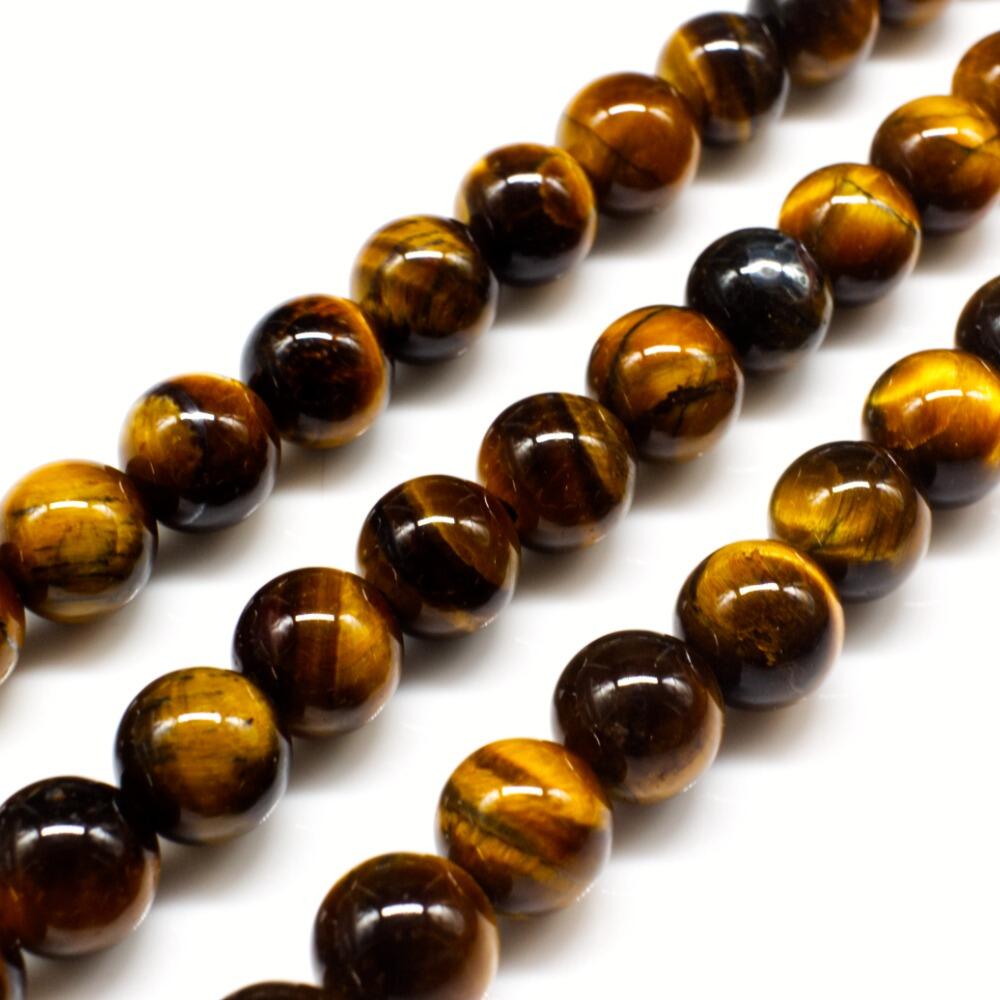
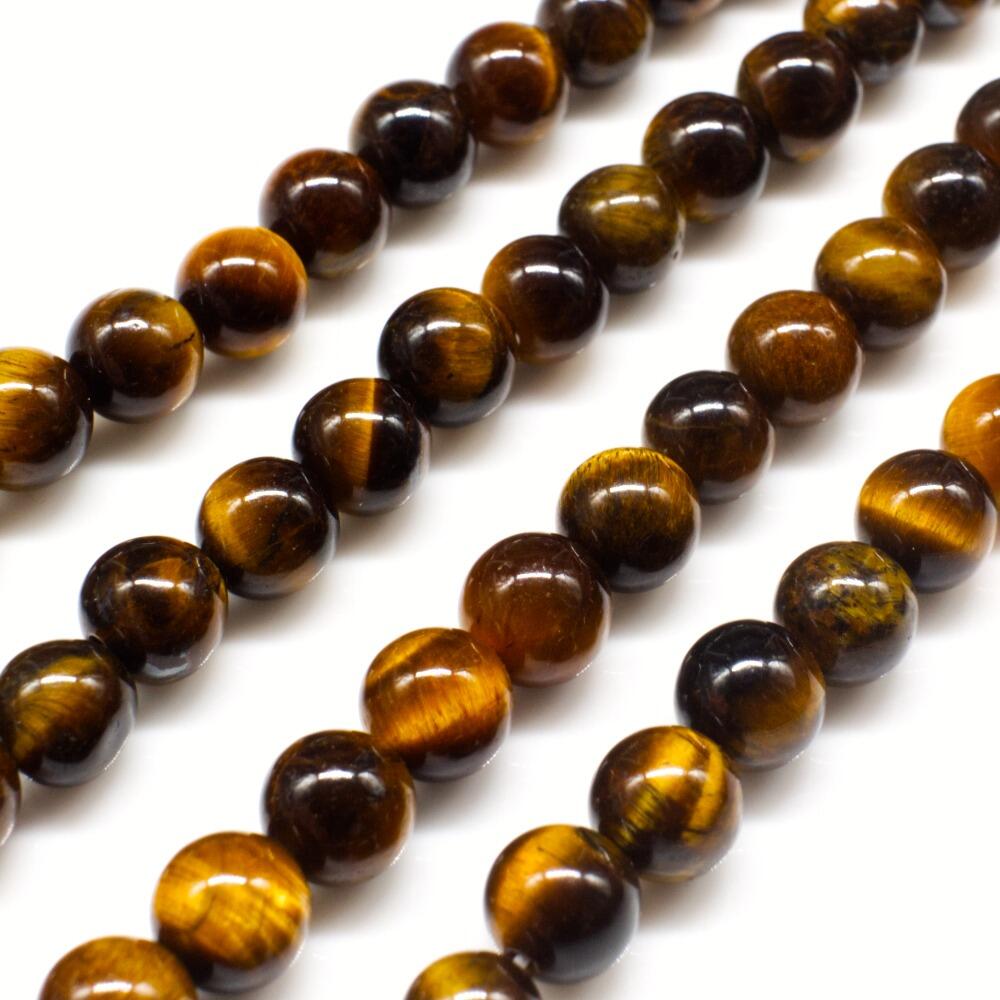
Tiger Eye Round Beads - 4mm 15" string
£5.50 Get the 4mm string
Tiger Eye Round Beads - 12mm 10 Beads
£6.99 Get the 12mm pack
Black Tiger Eye Rounded Rectangle 18mm
£7.00£15.75 Shop the 18mm rectangles
Which bead size do you need, and how many?
Pick 8 mm for a standard bracelet. It is the size that reads as substantial without being heavy, it suits both men's and women's wrists, and it is the size most tiger eye bracelets you have seen were made from.
Here is the arithmetic nobody publishes. A 15 inch string is 381 mm of beads laid end to end. Divide by the bead diameter and you have the count.
Two bracelets per string at almost every size, with a handful spare. That spare handful matters more than it looks, because it is what lets you make matching earrings or replace a bead you chip while finishing.
Measure first
Measure the wrist before you commit. Wrap a soft tape measure around it, palm up, snug but not pinching, and read the number in centimetres. For a stretch bracelet, work to the wrist measurement itself. The elastic takes up the difference and a bracelet built 1 cm longer than the wrist will spin and slide all day.
4 mm suits delicate stacking pieces and works as an accent between larger beads. 6 mm is the everyday size for a slimmer wrist. 8 mm is the default. 10 mm and 12 mm are the men's-gift sizes and the ones that sell hardest in the run-up to Christmas and Father's Day.
Gemstone chips are a separate proposition. A 32 inch chip string gives you a completely different texture for very little money, and it suits multi-strand and memory-wire work where uniformity is not the point. Browse the gemstone chip range if that is the look you are after.
What do you string tiger eye on?
The hole decides everything. Most tiger eye rounds are drilled at 0.8 mm, which rules out thick cord and rules in three sensible options.
Round elastic at 0.8 mm is the standard for a stretch bracelet. It fills the hole properly, which stops the beads sawing at it, and it takes a surgeon's knot cleanly. A 10 metre reel makes a lot of bracelets. Our beading elastic range has clear at 0.6, 0.8 and 1.0 mm alongside coloured flat cord.
Tigertail wire suits a clasped bracelet. It is nylon-coated steel, it will not stretch, and it finishes with crimps rather than a knot. Pick 0.38 mm for an 0.8 mm hole so you can pass twice through the end beads. The tigertail range covers the useful gauges.
Beading thread is the wrong choice here and worth naming as such. Tiger eye holes are drilled, not moulded, and the inner edge is often sharp enough to abrade thread over months of wear.
Finish a stretch bracelet properly or it will fail. Tie a surgeon's knot, then a second overhand knot on top. Put a single drop of jewellery glue on the knot, let it cure fully, then pull the knot back inside the nearest bead so it sits hidden. Trim close. A knot left proud of the beads is the commonest reason a handmade stretch bracelet snaps within a month.
For a clasped version, a lobster clasp on a short extension chain gives the wearer some adjustment. The clasp range covers lobster, magnetic and toggle, and magnetic is worth considering for anyone giving a bracelet to someone who struggles with small fastenings.
Elastic Round Clear - 0.6mm 15 Metres
Thin round cord for smaller drill holes, 15 metres per reel
What does a tiger eye bracelet cost to make?
Take an 8 mm golden string at around £10 to £12 and a metre of 0.8 mm elastic at pennies. Two bracelets from that string puts your material cost somewhere near £5 to £6 each, before your time and before packaging.
That number is the one to know before you price anything for a craft fair or an online shop. It is also the number that makes the case for buying the full quantity up front rather than a string at a time.
A worked example
A maker building six matching 8 mm golden bracelets for a family Christmas order bought three strings in one go, counted 47, 46 and 48 beads off them, and had enough for the six bracelets at 24 beads each plus fourteen beads spare. Those spares became a pair of earrings. Ordering the three strings separately over six weeks, as originally planned, would have brought in two visibly different batch tones across the set, and a matched set is the entire point of a family order.
A second one, the other way round
A seller stocking a summer market wanted variety rather than uniformity. She bought one string each of golden 8 mm, blue 6 mm and a chip string, and built nine bracelets across three price points from roughly £22 of stock. The chip strings did the heavy lifting on the lowest price point, where the margin per piece is thinnest and the volume is highest.
What pairs well with tiger eye?
Tiger eye is warm, banded and busy, so it wants quiet neighbours. Three combinations do the work.
Tiger eye and hematite. The grey metallic sheen of hematite against golden banding is the most reliable men's-bracelet combination there is, and it costs very little to test. The hematite range covers rounds, faceted shapes and finishes.
Tiger eye and black. Matt black onyx or black tiger eye between golden rounds breaks the pattern up and stops a long run of banding reading as noise.
Tiger eye and wood. Warm on warm, light in weight, and the right answer for a summer or festival piece using wooden beads.
Metal spacers change the rhythm more than people expect. A single brushed silver or antique bronze spacer bead every four beads reads as considered. One every other bead reads as fussy.
Hematite Round Beads 8mm
The classic partner for golden tiger eye in a men's bracelet
How do you look after tiger eye?
Wipe it with a soft dry cloth. That is the routine.
✗Keep it out of an ultrasonic cleaner, because the vibration works along the fibrous structure and can open flaws you cannot see.
✗Keep dyed material out of prolonged strong sunlight, where surface dye will fade over a season on a windowsill.
✗Store bracelets flat and apart from harder stones, because tiger eye scratches against anything harder than it.
Take it off before swimming, before the shower and before applying perfume or hand cream. None of that will destroy a bracelet overnight. All of it dulls the lustre over a year, and lustre is the whole point of the stone.
Buying tiger eye beads in the UK
Four things separate a good string from a frustrating one, and only one of them is price.
The listing states the hole size. Without it you are guessing at elastic gauge, and a 0.6 mm hole with 0.8 mm elastic is a wasted evening.
The colour treatment is disclosed. Dyed is fine. Undisclosed is not.
The drill is clean. Chipped drill exits catch thread and elastic and eventually cut through.
Stock is restocked, not deleted. A supplier who removes a sold-out page leaves you unable to reorder the same colour for a second batch.
TotallyBeads lists the size, the string length and the hole diameter on every gemstone listing, and matching elastic, tigertail and findings sit in the same basket so one order covers the whole build. Same-day dispatch runs on orders placed before 12 noon from Clacton-on-Sea.
If you would rather start from a kit than assemble the parts, the bracelet kit range includes everything needed for a first piece.
Faith Gemstone Bracelet - Tiger Eye
£7.25 Buy the Faith kit
Ciara Gemstone 4 Bracelets - Tigers Eye
£10.00 Buy the Ciara kit
Rahima Slider Bracelet - Tigereye Gemstone
£13.49£14.99 Discover the Rahima kit
Tiger eye bracelet FAQ
What does a tiger eye bracelet mean?
Tiger's eye has long been associated with steadiness, focus and quiet confidence, and it is often chosen as a gift to mark a new job, a move or a difficult stretch. The meaning is symbolic and traditional. No stone has any medical or protective effect.
Which wrist do you wear a tiger eye bracelet on?
Tradition puts it on the left. In practice, wear it on whichever wrist it sits comfortably and does not catch on a watch or a cuff.
Is blue tiger eye natural?
Yes. Blue tiger eye is known in mineralogy as hawk's eye and represents an earlier stage of the same alteration process that produces the golden form. Bright vivid blues sold as midnight blue are usually dyed, which is a different thing.
How many tiger eye beads do I need for a bracelet?
About 24 beads at 8 mm for a 19 cm wrist, about 32 at 6 mm, and about 19 at 10 mm. A 15 inch string holds roughly 47 beads at 8 mm, so one string makes two bracelets with a few spare.
Can tiger eye go in water?
Brief contact does no harm. Prolonged soaking, chlorinated pool water and salt water all dull the surface over time, and dyed material can lose colour. Take a bracelet off before swimming and before showering.
What is the difference between tiger eye and tiger iron?
Tiger's eye is the banded quartz material on its own. Tiger iron is a rock containing tiger's eye together with red jasper and black hematite, giving broad contrasting bands. Tiger iron is mined mainly in South Africa and Western Australia and suits larger focal beads.
Choosing your tiger eye
Start with an 8 mm golden string and 0.8 mm clear elastic. That combination makes two bracelets, costs under £12 in materials, and teaches you more about the stone in one evening than any amount of reading. From there, blue tiger eye gives you a cooler palette, chips give you texture at low cost, and 10 mm gives you the size that sells as a men's gift.
Buy the full quantity of one colour in a single order, check the hole size before you pick your elastic, and keep the finished piece out of the ultrasonic cleaner. Those three habits cover almost every way a tiger eye project goes wrong.
Browse the tiger's eye bead range to pick a size, explore the wider semi-precious gemstone range for stones to pair it with, or read our guide to gemstone, pearl and natural bead meanings, care and design ideas for the wider picture across natural materials. For sizing and hole questions across every bead type, our guide to bead sizes and hole sizes for stringing is the one to keep open while you order.
Related reading
Understanding bead sizes and hole sizes for stringing
The gauge-and-hole companion to the stringing section above, across every bead family.
Complete guide to bead types and materials for jewellery making
Where gemstone sits against glass, pearl, wood and metal once a piece is actually worn.
Make your tiger eye bracelet
Golden rounds from 4 mm to 12 mm, with the size, string length and hole diameter on every listing. Order before 12 noon and it leaves Clacton-on-Sea the same day.
Shop tiger's eye beadsShop beading elastic
Join the Bead Club for member pricing, watch the Facebook tutorials for stretch-knot technique, or call our Clacton team on 01255 431629.